

July 17, 2026
9 minute read

DIY Home improvement projects no longer start in a store aisle. They start in a chat window.
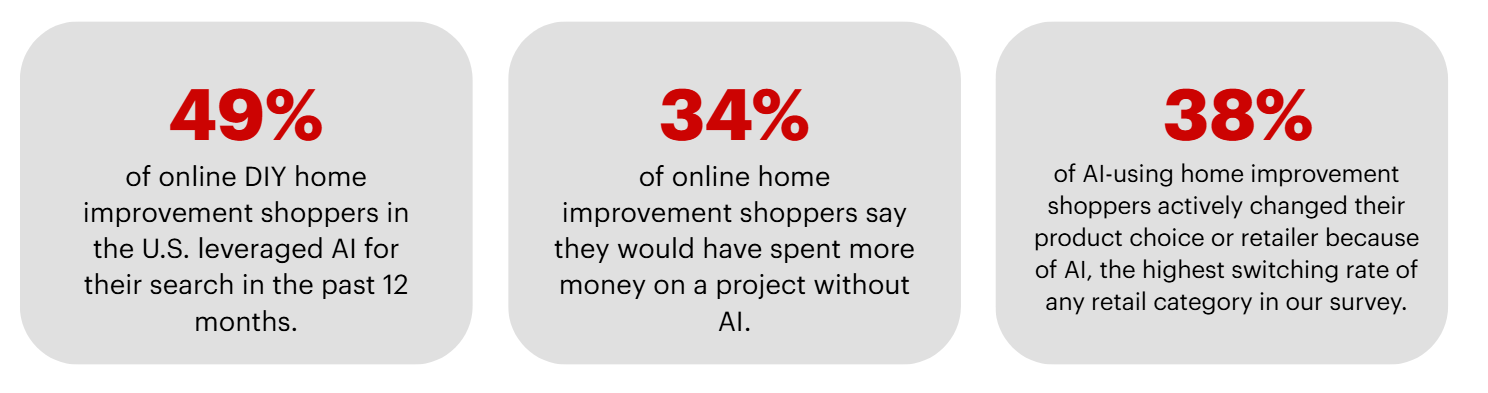
Nearly half of U.S. consumers who planned and/or purchased home improvement items or project materials online used AI to do so, and 4 in 5 of them turned to AI before visiting any retailer’s site or store. By the time they reach you, the plan is largely set: what to build, what to buy, and where.
For home improvement retailers, the question is no longer whether AI is in the journey. It’s knowing exactly where in that journey you keep the customer and where you lose them.
The value these customers are seeing isn’t marginal. 49% say they would have taken longer without AI, 34% would have spent more money, and a further 17% say they might not have completed the purchase at all without the confidence AI provided them.
NPS Prism, in partnership with Dynata, surveyed nearly 3,000 U.S. consumers who planned DIY home improvement projects and purchases to understand what that shift looks like in practice: when AI enters the journey and when it exits, how it changes what customers buy and where, which tools shape those decisions, and where retailers still hold an edge.
AI shapes the plan, then hands off the purchase
The research-heavy nature of home improvement projects makes AI a natural fit: consumers planning projects and purchases need to figure out what they need, compare materials, understand quantities, and plan sequences before they can buy anything.
Among shoppers who used AI, it enters the journey at the very first step and stays through comparison, then falls away as the transaction nears.
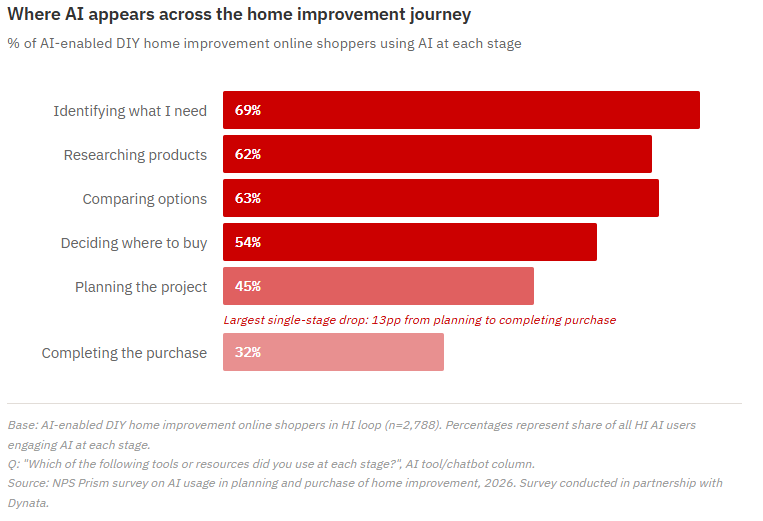
Usage is heaviest at “identifying what I need” (69%) and declines to 32% at purchase, with the sharpest single-stage drop, 13 percentage points, between planning and buying.
Home improvement shoppers let AI shape the project, then transact on familiar channels. That moves the contest upstream: which product a shopper chooses, and which retailer they buy from, is increasingly decided at identification and planning, before your site, your store, or your associates enter the picture. And that early stretch of the journey is exactly where most retailers have the least insight into customer behavior and preferences.
AI isn’t just confirming plans, it’s changing decisions
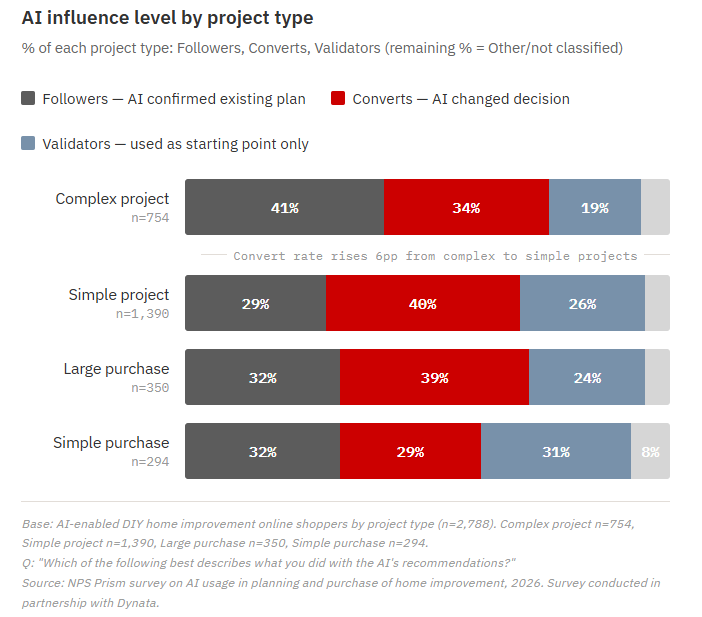
Not everyone uses AI the same way. Some shoppers arrive with a plan and let AI confirm it, while others treat it as a starting point. A substantial third portion had their decisions actively changed by what AI recommends: Across every project/purchase type we looked at, AI changed the individual’s decision for between 29% and 40% of them.
Where it changes the most decisions runs against likely assumptions: You might expect AI to matter most on the complicated jobs, where people need the most help, but the highest rate of AI-changed decisions shows up on simple projects (40%) and large purchases (39%), not complex ones (34%). On complex projects, AI more often confirms a plan the shopper already had (41%) than changes it.
AI widens the consideration set, and the retailer with the widest catalog benefits
AI is widening the funnel, not narrowing it. 46% of shoppers say AI showed them more products than they would have considered otherwise, against 21% who say fewer. AI also gave them more stores and purchasing channels to consider: 45% considered more, while only 18% considered fewer.
The brands and products that AI surfaces when it builds the plan have a meaningful impact on competitive share. 38% of AI-using shoppers actively changed their product choice or retailer because of AI, the highest switching rate of any retail category NPS Prism has surveyed.
That switching may not work in favor of traditional retailers. It flows to whoever the model can see most easily: structured product data, price, and reviews. These inputs all favor Amazon’s digital marketplace over the in-store expertise, material samples, and project associate knowledge that historically provided traditional retailers with a structural advantage. NPS Prism data reveals Amazon saw an 11-point gain in brand share when AI led the purchase decision, the largest shift among retailers. This happens at a stage most retailers don't measure and can't yet influence.
Third-party AI dominates the planning stage. Retailer tools arrive too late.
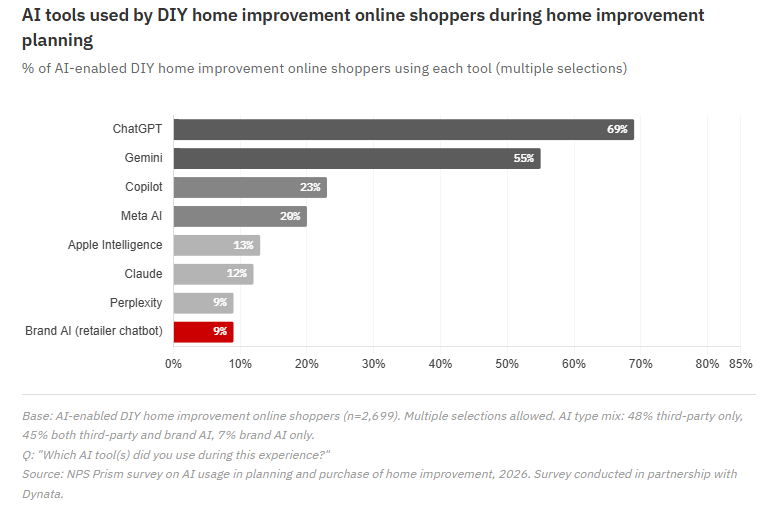
Third-party AI tools account for 93% of AI use in home improvement, led by ChatGPT (69%) and Gemini (55%). Only 9% of shoppers leveraged a retailer's own AI chatbot. This means the AI shaping material choices, retailer selection, and project plans for most shoppers is a general-purpose tool with limited access to your inventory, local availability, or the customer’s purchase history.
Where retailers do offer an AI assistant, the gap is one of fit and timing, rather than quality: 39% of shoppers who tried a retailer’s chatbot found it helpful, yet 24% did not know it existed and another 24% prefer a standalone AI. Retailer chatbots also appear too late in the customer journey: they are mainly built for product search and order tracking, while customers need them primarily for project planning and material specification.
Retailers still have an advantage, but need to leverage AI at the right journey moments
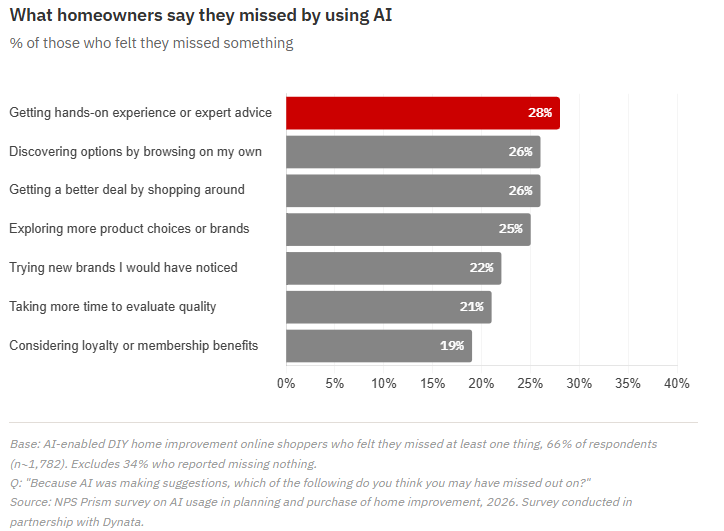
AI is delivering genuine value to home improvement consumers. It saves time, reduces spend, and gives people the confidence to take on projects they might otherwise defer or outsource. Yet, while AI can tell a shopper which tile to buy, it can’t stand beside them and show how materials will hold up under specific conditions, the way an in-store employee can. Among shoppers who felt they missed something, the most common gap was hands-on experience and expert advice, and that gap is the structural advantage retailers should hold onto.
The catch is timing. By the time the customer reaches your experts, AI has already built a shopping list from a catalog that may not be yours. The competitive response isn’t to improve the in-store experience at the end of the journey, but to get into the AI conversation before the list gets built.
Retailer AI needs to surface at the point of project initiation and be built around the project, not the product. The shopper planning a deck remodel doesn’t need a chatbot that searches “composite decking boards.” They need one that asks the right questions, generates a complete materials list, calculates quantities, and adds everything to a cart. This is the journey moment retailers need to own, and those who do so first will gain the competitive advantage in the industry.
How do you stack up in a new competitive landscape?
This AI shift is playing out upstream, in planning, before customers reach a store or a sales figure. It won't be the last shift to change how customers choose, and the trends that catch retailers off guard tend to be the ones they can't spot in their own data until the results are already in. Staying ahead of that takes a standing, competitive read on your customer journey: the ability to see where you lead competitors, where you lag, and what's driving the gap.
That's what NPS Prism provides: journey-level competitive intelligence that shows where you stand against competitors across the customer journey and what's behind each gap, so you can catch where your position is moving and act on it, instead of putting the pieces together after the fact.
See where you're losing customers at the planning stage.

Survey conducted in partnership with Dynata.
.jpg?width=300&height=77&name=Dynata%20logo_Full%20Color_2025%20(2).jpg)
About Dynata
Dynata is the world’s largest first-party data company for insights, activation, and measurement. With a reach that encompasses millions of consumers and business professionals globally, and an extensive library of individual profile attributes collected through surveys, Dynata is the cornerstone for precise, trustworthy quality data. The company has built innovative data services and solutions around its robust first-party data offering to bring the voice of the customer to the entire marketing continuum — from uncovering insights to activating campaigns and measuring cross-channel marketing return on investment. Dynata serves more than 6,000 market research, media and advertising agencies, publishers, consulting and investment firms, and corporate customers in North America, South America, Europe, and Asia Pacific.