

October 1, 2026
3 minute read

Most companies treat the handoff of a customer from an AI service bot to a human agent as a fallback: something that only needs to happen when the bot has failed to meet a customer’s needs. According to NPS Prism's latest cross-industry CX intelligence study, this assumption can come at heavy cost to NPS performance.
We surveyed customers about their experiences with AI chatbots from 40 major banking, retail, telecom, and airline brands. We found that the timing of the handoff from bot to human can determine whether the interaction strengthens or weakens a customer’s likelihood to recommend your brand.
Waiting for the bot to fail creates a measurable NPS loss
Two handoff scenarios: a reactive handoff, in which a human agent steps in only after the bot fails to resolve the issue, and a proactive handoff, in which human support is offered earlier in the conversation, before the bot reaches that point.
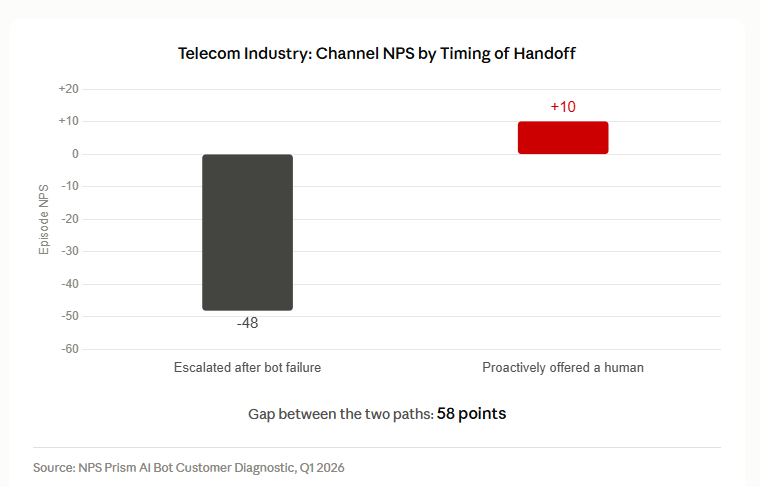
The difference is substantial. In telecom, episode NPS is –48 when customers are transferred to a human only after the bot fails, compared with +10 when human support is offered proactively —a 58-point gap. The pattern extends across industries, with airlines, banking, and retail each showing differences of more than 50 points between the two handoff approaches.
Proactive support prevents frustrating bot experiences
The bot's capabilities are the same in both scenarios, What changes is when customers are given the option to switch to a human, and that timing can fundamentally reshape the experience.
With a reactive handoff, the customer may have already repeated their issue, encountered a loop, and watched the bot fail to resolve their problem. By the time a human agent steps in, the interaction has already cost the customer time and patience the company can't get back.
A proactive handoff changes that trajectory. By offering customers the option to connect with a human before the bot reaches its limits, companies can help those who accept avoid the frustration inherent in a model that requires the bot to fail before support becomes available.
That makes handoff timing a powerful experience lever that does not require any new AI capabilities. It simply requires treating escalation as an intentional design choice rather than a last resort.
Handoff timing is one of several areas examined in our AI Chatbot Customer Interactions Diagnostic Report. The report enables companies to benchmark AI chatbot performance at the journey-moment level against named competitors, including where escalation timing is protecting or eroding NPS. It also breaks out escalation performance by industry, and provides leader, average, and laggard NPS benchmarks for each one.