

August 14, 2026
13 minute read

AI increasingly favors the platforms it can compare on price over the loyalty hotels have spent decades building. For hotel brands, the response has to start now.
Hotels and OTAs have largely been competing to own the customer booking journey since the mid 2000s, and over the past decade, loyalty tiers, app experiences, on-property service, and direct-booking perks have become the tools of that fight. All of them assume the guest arrives already choosing between the brand and a short list of rivals.
For the growing number of consumers who now plan trips with AI, that assumption is breaking as third-party AI tools send travelers to a short list of platforms before brand loyalty ever gets a chance to compete.
NPS Prism's latest hotel research, from a joint study with Dynata of more than 2,300 US travelers who used AI to plan or book a trip, points to three shifts hotel operators need to act on to continue winning direct bookings:
- AI is now making the hotel choice and steering it towards OTAs.
- AI does so upstream of the hotel's own channel, taking the booking and the guest relationship with it.
- AI still cannot see the one asset built to bring guests back: loyalty. This is where the strategic response from hotels must start.
AI is making the hotel choice, and steering it towards aggregators and online travel agencies
Consider how far AI has already moved into the decision itself. Four in ten travelers who used AI to book a hotel say it changed which hotel they chose. It did more than narrow their search or save them time. For these travelers, it altered the outcome.
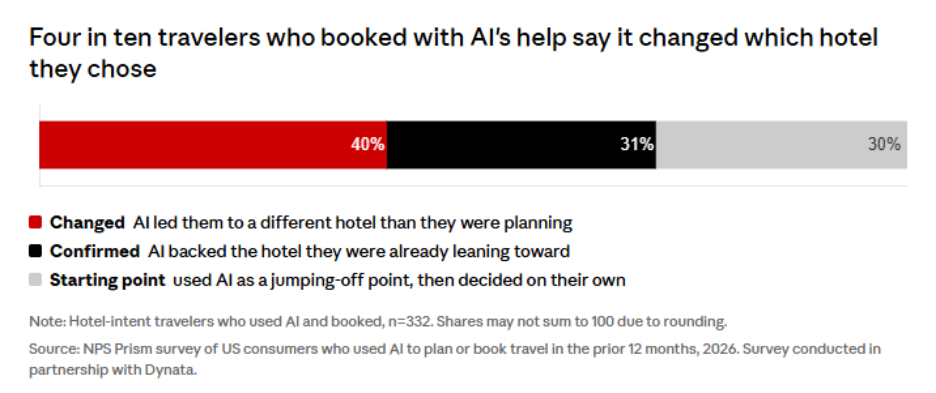
When AI decides, it also narrows the consideration set, typically to a short list of two or three options. It builds that list from what it can see from the outside: price and availability. That plays to the aggregators and online travel agencies, which line up inventory on exactly those terms, while a hotel brand's strongest advantages stay invisible from the outside.
A loyalty program is exactly that kind of invisible advantage. It pays off only once a guest is inside a brand's own app, long after the choice is made. The result is a steady consolidation of demand toward the platforms and away from individual chains.
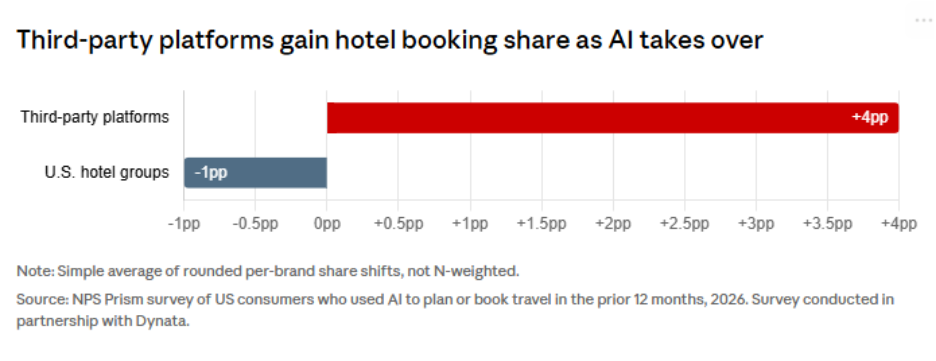
By the time the guest reaches the hotel, the relationship has already moved on
This consolidation would matter less if the booking went directly to the hotel, but only 38% of transactions do. The majority of AI-assisted bookings happen elsewhere, with 44% landing on an online travel agency and 8% booking in the AI tool itself.
That 8% is likely to grow. Google has begun testing agentic hotel booking that completes the booking directly inside their AI platform, rather than just helping travelers search and compare options.
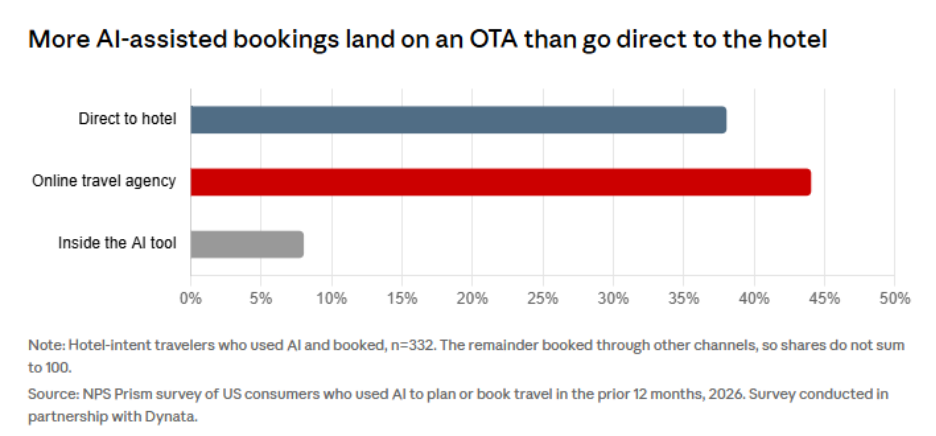
Every step away from a direct booking is a step away from the enrolled member, their first-party data, and their reason to return.
The recommendation happens in AI. The transaction happens on an OTA. Only the stay happens with the hotel.
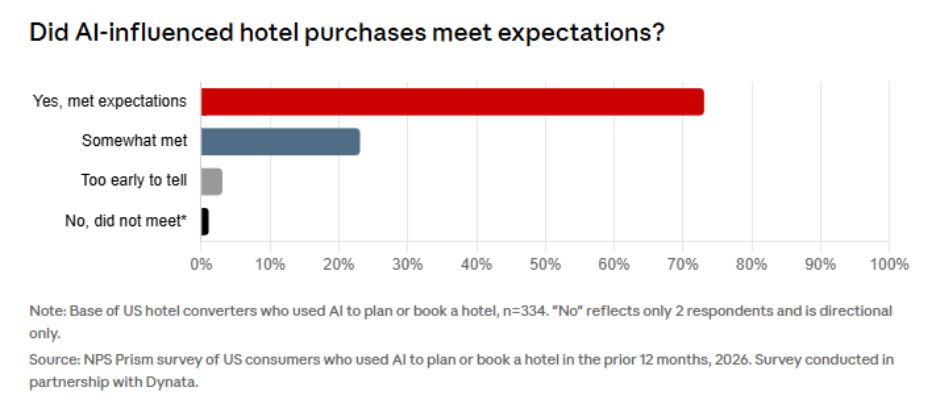
None of this runs against travelers' wishes. The more they rely on AI, the more they trust it, and three-quarters say the result met their expectations. That trust is real, but it accrues to the AI and the platforms it surfaces, not to the hotel that delivers the stay. A guest who trusts AI to pick a good hotel has little reason to stay loyal to any single brand.
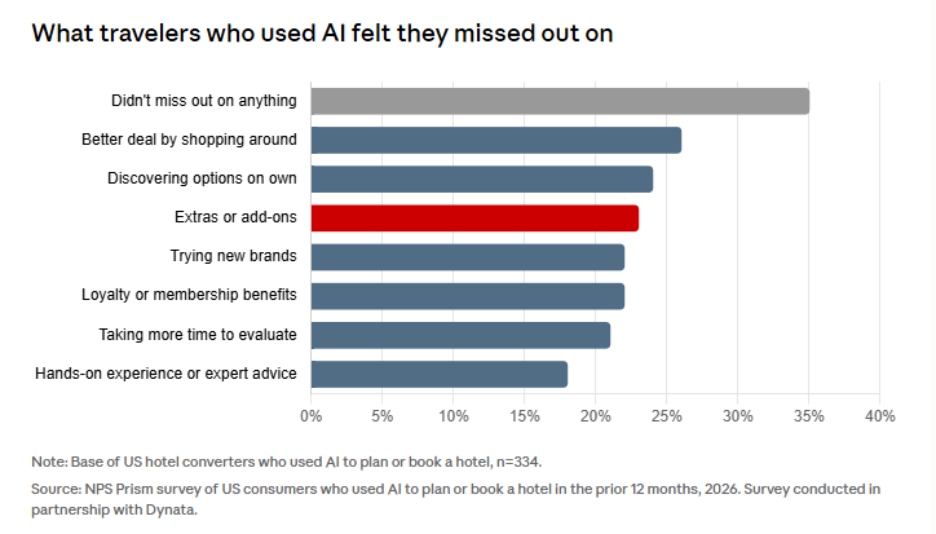
The bookings that do come in are also worth less than they used to be. AI compresses the path from search to reservation, and the merchandising steps in between get skipped. Those are the moments where a hotel sells the upgrade, the package, the dining reservation, the spa treatment, so a stay booked through AI can arrive stripped of the extras that carry the margin.
In this survey, travelers who let AI handle the booking picked up fewer of them, and the gap is noticeable. 23% of travelers who booked hotels through AI reported that they felt they missed out on extras and add-ons. A hotel with no capable AI of its own in that flow has no way to put the offers back in front of the guest.
Loyalty is one thing AI can't see
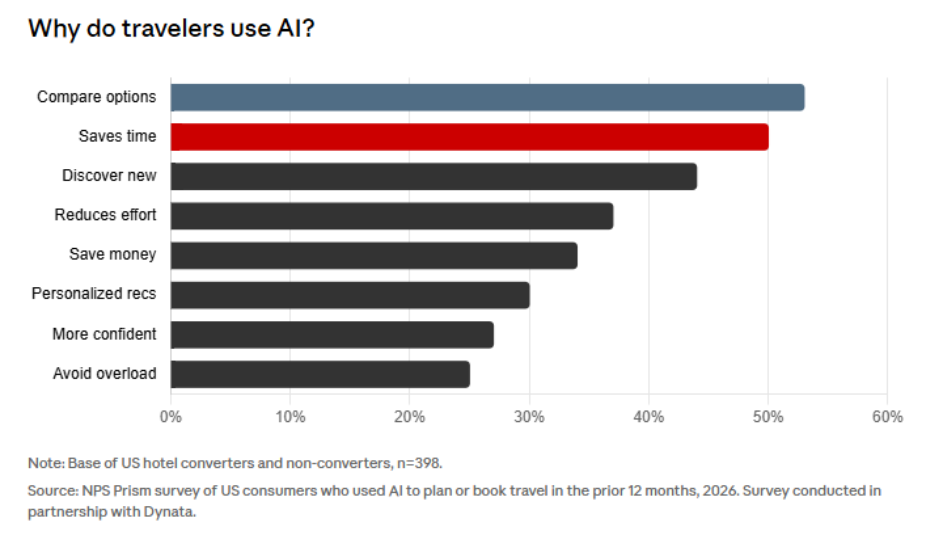
The same survey also points to how hotels can respond, by revealing what AI is not built to do. More than half of travelers who used AI to plan or book travel did so to compare options and save time, the two dominant reasons by a wide margin. Personalization ranks far lower, cited by only about a third. What AI delivers is efficiency: these travelers spend less without trading down to cheaper rooms. A relationship is not part of the package, and the personal, loyalty-aware experience AI cannot provide is exactly what a hotel's own data and channel are built to create.
That gap is the opening, and the strongest chains are already moving into it. Marriott, for example, is treating AI as a way to pull travelers deeper into Bonvoy rather than a threat to it, and has begun rolling out natural-language search across its own site and app. IHG is going further on data, building a single loyalty and customer-data platform with an AI-powered content management system designed to anticipate what a guest wants next rather than react to what they did.
This reframes the loyalty program from a cost center into a hotel's most defensible asset. To book a stay that genuinely suits a guest, an AI agent has to source that guest's preferences from somewhere. A hotel that makes the agent come to it for that data keeps the agent dependent on the brand. A hotel that lets the data leak to the platform allows the agent to learn the guest once and never return. A decade of loyalty investment turns out to be the groundwork for this moment, and the chains that treat it that way will be the ones AI keeps choosing.
What hotels should do now
The shift in booking share is already accelerating. Google's tests are a signal that the AI tools sending demand elsewhere today intend to capture more of it in the near future. Waiting to build direct relevance until that infrastructure matures will be too late. Three moves follow, and none can wait for the technology to settle.
- Get your brand into the AI recommendation. AI selects hotels on value and comparability, so if your rates, inventory, and content are not clean, structured, and machine-readable, you are cut before a guest ever considers you. Treat readiness for AI recommendation as a guest-experience priority, not a technical afterthought.
- Make your loyalty data the thing an AI agent has to request. The elements an agent cannot route around are the ones worth funding: stay history, stated preferences, and tier status with its attached benefits—data an agent can use only by coming through your own channel. Fund those, not the parts it can find anywhere.
- Compete where AI is weak. Value and speed are a contest AI platforms are structured to win. Personalization and loyalty-aware service are the ground these tools do not own, and your own data and channel are built precisely for them.
AI will keep choosing hotels for travelers. The open question for any hotel group is whether AI keeps choosing it, and whether guests return without prompting. Answering that requires watching the competitive shift where it occurs: which rivals and which platforms are winning the guests a hotel is losing, journey by journey rather than in a single top-line score.
NPS Prism helps hotel operators see exactly that: where they are winning and losing guests, journey by journey and against named competitors. See how you compare today.

Sources and notes
Survey findings draw on a 2026 NPS Prism and Dynata survey of US consumers who used AI to plan or book travel in the prior 12 months (n = 2,287 AI travelers; 1,846 converters). Figures on how AI affected the hotel decision use hotel-intent travelers who converted (n = 332).
Survey conducted in partnership with Dynata.
.jpg?width=300&height=77&name=Dynata%20logo_Full%20Color_2025%20(2).jpg)
About Dynata
Dynata is the world’s largest first-party data company for insights, activation, and measurement. With a reach that encompasses millions of consumers and business professionals globally, and an extensive library of individual profile attributes collected through surveys, Dynata is the cornerstone for precise, trustworthy quality data. The company has built innovative data services and solutions around its robust first-party data offering to bring the voice of the customer to the entire marketing continuum — from uncovering insights to activating campaigns and measuring cross-channel marketing return on investment. Dynata serves more than 6,000 market research, media and advertising agencies, publishers, consulting and investment firms, and corporate customers in North America, South America, Europe, and Asia Pacific.