

April 29, 2026
11 minute read
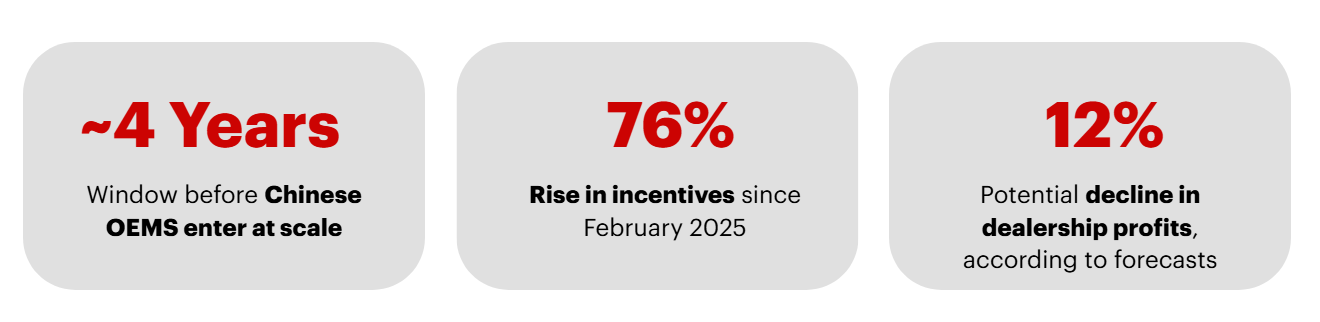
Industry forecasts are clear: the U.S. auto industry has approximately four years before Chinese OEMs establish a meaningful stateside presence. While tariffs are delaying the risk, the structural cost advantage Chinese manufacturers hold in electric vehicles is significant and headed to the dealership down the street.
The U.S. dealers and OEMs still winning when the timer is up will be the ones who make the customer experience so strong that switching becomes unthinkable.
This is the message coming from leaders at major OEMs, experts from the National Automotive Dealers Association, and the data on how AI is already transforming the way Americans shop for cars.
How close are Chinese automakers to entering the U.S. market?
At CES 2026 in January, Geely's global communications team confirmed that the company expects to announce a U.S. entry for its Zeekr and Lynk & Co brands within the next two to three years. Geely already has infrastructure in place: Volvo's factory in South Carolina is undergoing a $1.3 billion expansion that could serve as a production base for Chinese-designed vehicles built on American soil.
The Alliance for Automotive Innovation, the trade group representing America's largest automakers, warned in its February 2026 report that the entry of Chinese state-backed vehicles could represent what it called a severe existential threat to the domestic auto sector. BYD, which overtook both Tesla and Ford in global sales in 2025, has unveiled fully electric crossovers at price points that dramatically undercut anything currently available in the U.S.
Meanwhile, Canada has already moved. In January 2026, a trade deal was announced allowing up to 49,000 Chinese-built EVs into the Canadian market. The U.S. tariff wall is delaying direct imports, but experts increasingly agree the question is when, not whether, Chinese vehicles reach American dealerships.
For CX leaders at OEMs and dealership groups, the implication is straightforward: the window to build customer loyalty strong enough to withstand a pricing disruption is measured in years, not decades.
In a time of margin compression, customer retention is a growth lever
The volume-and-discount model that defined the last decade is losing steam. Transaction prices are rising — partly from tariffs, partly from semiconductor-driven supply constraints — but incentives are rising just as fast, up 76% from February 2025. Industry forecasts suggest dealership profits could decline roughly 12% in 2026, even while overall sales remain steady. The trend line is clear even if the absolute numbers remain strong.
For CX leaders, this means the conversation with their CFO has changed. In an expanding market, customer experience investment competes with volume plays. In a margin-compression environment, retention is the growth lever — and anything that demonstrably reduces churn, increases repurchase, or improves service attach rates moves to the top of the priority list.
Both Honda and Nissan have taken steps in this direction. Honda's VP of Sales has described their model as relationship-driven rather than transaction-driven, with a stated goal of 1.5 million units achieved through retention and lifetime customer value, not conquest.
Nissan's CEO, mid-turnaround, identified dealer relationships as a priority to rebuild — and acknowledged that product alone does not fix a strained customer relationship. The industry's leaders are converging on the same conclusion: the customer you keep is worth more than the customer you chase.
AI is reshaping the customer journey— and the dealer's role in it
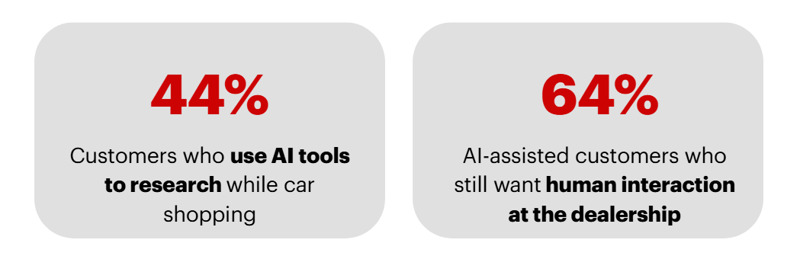
Nearly half of car shoppers are already using AI tools in their research, with major implications on their experience as a customer. These shoppers are more intentional: they return more often, save more vehicles, and move through the purchase funnel faster. They arrive at the dealership better informed and with higher expectations — which means the margin for error in the human interaction has narrowed.
That human moment — that critical handoff from AI-assisted research to in-person relationship — is where dealers win or lose. Sixty-four percent of AI-assisted shoppers still want human interaction at the dealership.
That number should be a source of competitive confidence, not complacency. It means the franchise model has a durable structural advantage — if dealers show up for it. Sales teams will need training to interact with a more informed, more demanding customer without letting process replace genuine connection, and the dealership experience should be designed around the moments that matter most.
Visibility is higher than ever, and trust must be truly earned.
AI tools now read every review, every response, and every unresolved complaint before recommending a dealership to a shopping consumer. Review volume, quality, and response discipline now directly shape AI-generated recommendations. The aggregate of all reviews is fully visible to any buyer using AI in their research process.
This heightened visibility changes the stakes of every service interaction. A slow response to a negative review, a pattern of unresolved complaints, or a staff issue that drives low scores in a specific department are no longer just internal metrics. They are competitive data that AI reads and acts on at scale.
Simply managing reviews isn’t enough—it will be necessary to run an operation that generates genuinely strong experiences, then make sure those experiences are captured, measured, and visible to consumers.
What CX measurement makes possible
The big challenge for CX leaders is not just identifying these trends but also connecting them to operational decisions with enough precision to justify investment and move business goals forward.
-
Which moments in the ownership lifecycle drive the most repurchase intent?
-
Where are competitors outperforming you, and on what specific dimensions?
-
Which dealer locations are driving loyalty, and which are eroding it?
Amid declining retail profit, answers to these questions are not a nice-to-have. They are what gets CX initiatives funded.
Dealers and OEMs that invest in rigorous, benchmarked CX measurement–understanding where they stand relative to direct competitors across the full ownership lifecycle—will be the ones who can quantify the ROI of experience improvements, direct resources to the touchpoints with the highest loyalty impact, and demonstrate to their leadership and boards that customer experience is not a soft metric but a measurable competitive advantage.
The tools to do this exist today. The question is who will deploy them aggressively enough to build the customer relationship moats that Chinese OEMs cannot easily replicate.
See where you stand.
NPS Prism benchmarks your customer experience against direct competitors across the full ownership lifecycle — so you know exactly where to invest before the competitive landscape shifts.
