

November 23, 2026
6 minute read

Across Southeast Asia, customers commonly spread their financial activities across multiple banks. Yet one institution typically handles the transactions and deposits they rely on most, and holds a greater share of their banking products.
NPS Prism research across six Southeast Asian markets (Singapore, Malaysia, Thailand, Indonesia, the Philippines, and Vietnam) shows that primary banks have broader product relationships with customers, while customers holding additional financial products report higher NPS. Banks looking to grow their share of customers' financial business should focus on the experiences that help them earn and strengthen primary banking relationships.
Win a larger role in customers' everyday banking
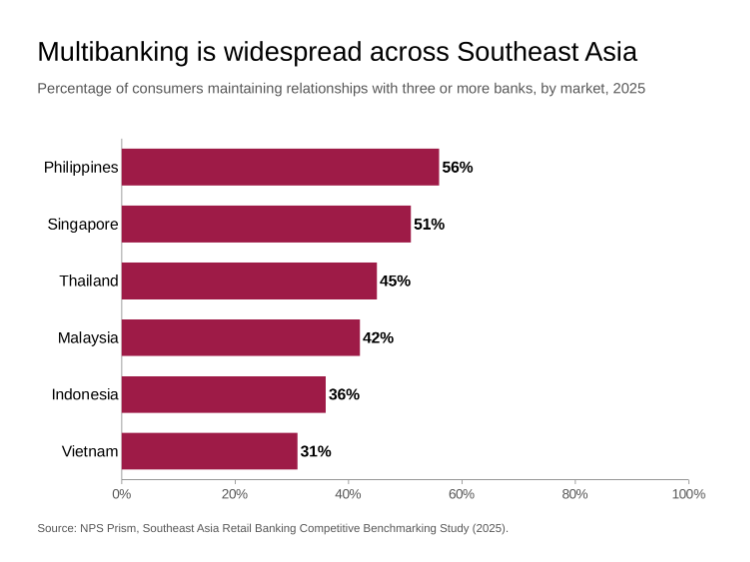
Multibanking is widespread across Southeast Asia. Between 31% and 56% of consumers in the six markets studied maintain relationships with three or more banks, including more than half of customers in the Philippines and Singapore.
Yet customers tend to rely on one bank for their most important financial activities. When asked what makes a bank their primary institution, respondents most often pointed to the bank they use for everyday transactions, followed by the bank receiving their salary deposits and the one holding most of their cash and assets.
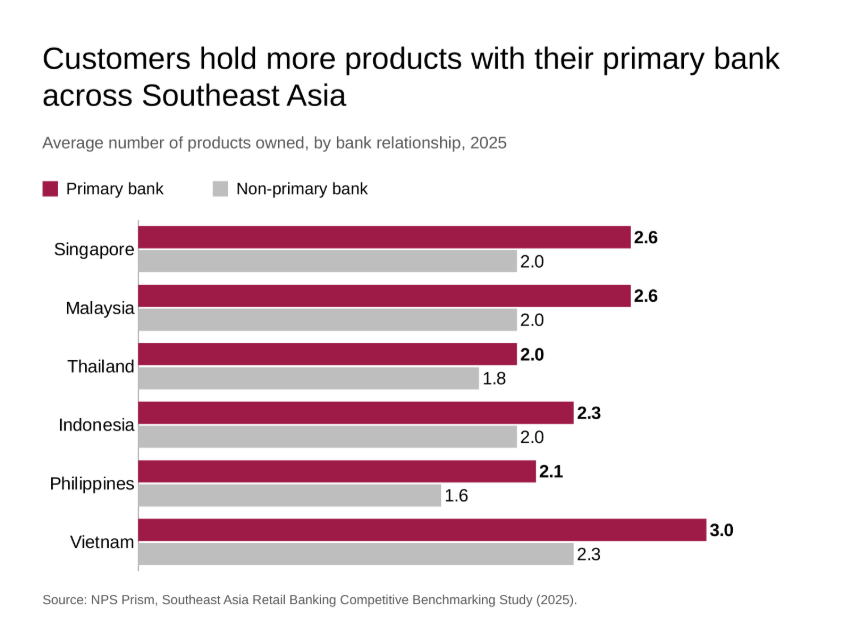
Across all six markets, customers also hold more products with their primary bank than with other banks. This makes the primary relationship especially valuable: it extends beyond occasional transactions or specialized financial needs.
Service quality also plays a role in customers' banking decisions. NPS Prism research found that approximately 40% of customers cited poor service related to app issues or branch queues among their reasons for switching banks.
Build trust through reliable service and proactive support
NPS Prism's research identifies several additional factors shaping the banking experience, including issue resolution, proactive communication, and support for more complex financial needs.
Approximately 70% of customers expect proactive communication during onboarding and issue resolution, according to NPS Prism research. Yet gaps remain in how banks anticipate customer needs and protect their accounts. For example, around 40% of respondents reported not receiving a fraud alert before a transaction occurred.
Together, these findings point to opportunities for banks to improve proactive communication, strengthen fraud protection, and reduce friction when customers move between service channels.
The most relevant priorities vary across the region. In Thailand, human service and empathetic issue resolution remain important differentiators. In Vietnam, convenient access to branches and ATMs continues to influence NPS. Banks need to understand which experiences matter most to their customers before deciding where to concentrate investment.
Strengthen advocacy as relationships expand
Primary relationships create opportunities to serve more of customers' financial needs, from everyday banking to lending, investments, and wealth management. Across all six markets, NPS Prism research shows that customers with additional banking products report higher NPS than those holding only current or savings accounts. In Malaysia, for example, industry NPS is 41 among customers with additional products, compared with 20 among those with deposit accounts alone. 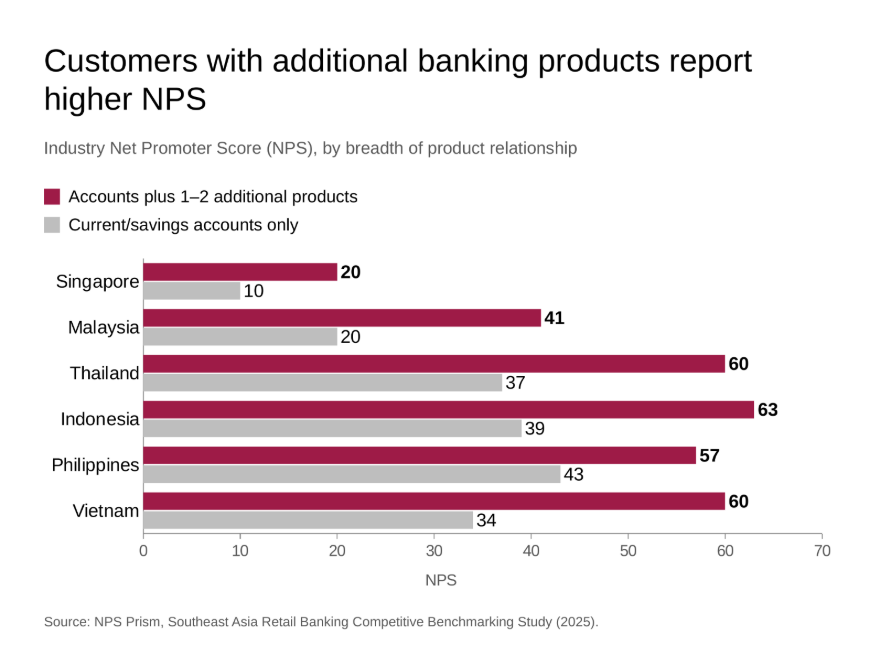
Broader product ownership does not necessarily cause higher loyalty. Customers who already have positive experiences may be more willing to entrust a bank with additional financial needs. Banks seeking to deepen these relationships should therefore pay particular attention to the experiences that accompany new products and more complex financial decisions.
In Singapore, for example, trusted wealth advice and effective coordination between relationship managers and digital channels are increasingly important as banks develop more complex customer relationships. The quality of advice, communication, and servicing can influence how customers perceive the institution across their financial needs.
Prioritize the experiences that earn primary relationships
The experiences that earn primary relationships vary across Southeast Asia. Competitive benchmarking and journey-level research help banks identify where to invest, from improving everyday transactions and addressing service failures to supporting customers with more complex financial needs. These insights can guide efforts to deepen customer relationships and strengthen loyalty.
See how your bank compares
NPS Prism's competitive benchmarking data helps banks understand how their customer experience compares with peers across key products and journeys. Request a personalized competitive review to identify where your bank leads, where competitors outperform, and which experiences warrant closer attention.
Tag(s):
Net Promoter Score
,
NPS
,
Customer Episodes
,
Financial Services
,
Banking
,
Consumer Banking